Saturday, August 27, 2011

Considering Our Fewness

“The LORD did not set His love on you nor choose you because you were more in number than any of the peoples, for you are the fewest of all peoples…” (Deuteronomy 7:7)

The word “fewest” or least (me'at, or LXX, oligos) is used for inconsequential (Gen 30:15), opposite of many (here, Num 13:18, etc.).

But:

"Your fathers went down to Egypt seventy persons in all, and now the LORD your God has made you as numerous as the stars of heaven.” (Deuteronomy 10:22)

How can both be true, to be the least but yet numerous as the stars? Rashi says that its that we act like we are the fewest. Other commentators say it is relative to other major peoples in the area, Egyptians, Assyrians, etc.

Notice in Deuteronomy 7:6 (as in 10:22) he is speaking to a 2nd person singular. I believe there HaShem is speaking to the people as a whole nation, one which is set apart as His people. In Deuteronomy 7:7-8 it switches to second person plural. This raises the possibility that He’s speaking to a different group—particularly, the remnant within the nation. Though we are many, it is the remnant of Israel who are few. And it is for the sake of the remnant that the nation is redeemed from Egypt.

Isaiah cries out concerning Israel: "Though the number of the Israelites is like the sand by the sea, only the remnant will be saved. For the Lord will carry out his sentence on earth with speed and finality." It is just as Isaiah said previously: "Unless the Lord Almighty had left us descendants, we would have become like Sodom, we would have been like Gomorrah." (Romans 9:27-29)

Now the remnant is the hope of the nation, the guarantee that one day all Israel will be saved, when they too believe in Yeshua.

Though there were many others, it was the few that was saved with Noah, 1 Peter 3:20. Only the few will enter into life.

Matthew 7:14 "For the gate is small and the way is narrow that leads to life, and there are few who find it.

Luke 13:23 And someone said to Him, "Lord, are there just a few who are being saved?" And He said to them, 24 "Strive to enter through the narrow door; for many, I tell you, will seek to enter and will not be able."

Revelation 3:4 “But you have a few people in Sardis who have not soiled their garments; and they will walk with Me in white, for they are worthy.”

Luke 12:32 "Do not be afraid, little flock, for your Father has chosen gladly to give you the kingdom.”

As a remnant, we would not exist or be sustained but by His grace (Rom 11:5).

For the sake of this world, the universe is secure; for the sake of Israel, the nations are secure; for the sake of the remnant, Israel is secure; it is for the sake of Messiah that the remnant is secure.

Friday, August 05, 2011

Mourn with those who Mourn


Tisha B’Av, which translates as the ninth of Av (this year it falls on Aug 8-9), ends a three-week period of semi-mourning which starts with the Fast of Tammuz. The ninth of Av, however, is the peak of this mourning period, where tradition prevents our people from shaving, eating, and entertainment. The reason for this distress is remembrance of events that have happened in the lives of the Jewish people. The rabbis teach that all these things happened on the ninth of Av:

· Sin of the spies which caused the Lord to decree that the people of Israel would not be permitted to enter the land.

· Destruction of the First Temple (586 BC)

· Destruction of the Second Temple (70 AD)

· Fall of Betar, the last fortress to hold out against the Romans during the Bar Kochba revolt in the year 135 AD. This sealed the fate of the Jewish people and beginning the exile from Judea

· One year after the fall of Betar, the Temple area was razed and plowed under by the Romans

· In 1492, King Ferdinand of Spain issued the expulsion decree, setting Tisha B’Av as the final date by which not a single Jew would be allowed to walk on Spanish soil.

· World War I – which began the downward slide to the Holocaust.

Its Meaning, Today and Tomorrow

Though most Jewish people are secularized and perhaps therefore unaware of Tisha B’Av, the Orthodox Jewish community takes it quite seriously. Thus if your Jewish friends and acquaintances are observing this day, treat them as one in mourning, and do not invite them to go out to eat, the movies or any other enjoyable events. In fact, though they may love you, do not expect them to greet you happily, which is not permitted on this day. They will be quite reserved, solemn and sad on this day.

The rabbis have identified this day with the fast of the fifth month (Av) as noted in Zechariah 7:5. This fast of the fifth month probably developed as a response to the Babylonian exile.

Zechariah goes on to say, “Thus says the LORD of hosts, … the fast of the fifth … will become joy, gladness, and cheerful feasts for the house of Judah…” (Zechariah 8:19). These “fasts becoming feasts” are traditionally understood as occurring in the messianic age, and then our sorrows will be turned to joy. In Messiah Yeshua we have certainly experienced the truth of the Lord’s grace transforming our sadness to gladness.

For those of us that have received Messiah’s forgiveness and fullness and can “rejoice in the Lord always” (Philippians 4:4), we are still responsible to care about those who are hurting and have compassion and even empathy in their distress.

Should Messianic believers observe Tisha B’Av today? To a large degree this depends on one's community. If one's witness to our people identifies with those who mourn, the Bible states that we should “weep with those who weep” (Romans 12:15). If your congregation is located in a particularly observant Jewish community, it is most appropriate to respectfully have a day of prayer for Israel and the Jewish people, or at very least not plan a celebration on that day.

In all things let us love as we have been loved and “comfort others with the very comfort we have received,” that in all events and on all days Messiah Yeshua may be glorified and His grace proven to be sufficient for all:

Blessed be the God and Father of our Lord Jesus the Messiah, the Father of mercies and God of all comfort, who comforts us in all our affliction so that we will be able to comfort those who are in any affliction with the comfort with which we ourselves are comforted by God. (2 Cor. 1:3-4)

Monday, April 25, 2011

Messianic Passover midrash

The events of and surrounding that first “Easter weekend” (Yeshua’s death, burial and resurrection) are closely tied to the Biblical holiday of Passover. (the word used for “Easter” in many Christian traditions still is “Pascha” or Passover). This closeness should highlight the twistedness of the hatred and persecution historically shown by Easter celebrants towards Jewish Passover celebrants. Moreover, when we see the legacy of Messiah Yeshua interacting (more positively) with Passover traditions, the main thing about this interaction which should be difficult to understand is why it is so difficult to understand. Funny then, to read these statements from a recent WSJ survey of the "multi-cultural significance" of Passover:
Some churches lead seders so congregants can better understand Judaism and the Jewish roots of Christianity. But others present the seder through a Christian lens—equating the seder's four cups of wine with the blood of Jesus, for example, and the unleavened bread (matzoh) with his body. They thus turn a Jewish religious ritual into a Christian one.
It is understandable that to equate Passover matzoh with the body of Yeshua, and the wine with his blood, may be scandalizing. One might think, “how dare they take Jewish customs for that purpose?” The writer above even goes so far as to contrast a seder like this which "turns a Jewish religious ritual into a Christian one" with other "multi-cultural" seders whose observance still "remains grounded in Jewish religious ritual, tradition and meaning." Let's not overlook that, far from being a creative transforming move on the part of Christians today, it is really the teaching of the New Testament writers, who were Jews working within Jewish categories. We are just mundanely re-discovering what they were saying. So, naturally, these parallels just happen themselves to be "grounded in Jewish ritual, tradition and meaning," and the author makes a false dichotomy. Whether those Jews were coherent, justified, or inspired in how they used those categories (I think they were all three) is a debate for apologetics. Regardless, it should be no surprise if Christians want to see things as they were intended. Its sad that some might even leave out such a basic reality for the sake of political correctness.

However, much of the seder has evolved over the centuries, both before and after the "parting of the ways" of Church and Synagogue (however one dates that). Believers in Yeshua coming back to the traditional seder after that split face a large time gap. Thus, the interaction between seder traditions from different time periods, and what it all means, can be confusing.

Well, confusing is one thing. Deceiving is quite another. And those who conduct Messianic seders are accused wholesale of deceptive transformations. I would like to consider what is allegedly one of the most egregious: taking the three pieces of matza to refer to the Trinity.

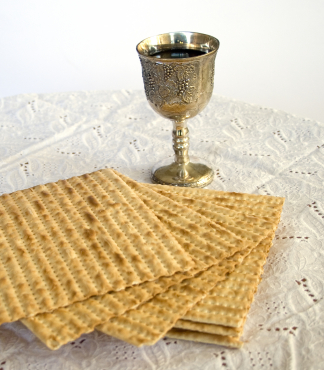
A little explanation is in order. On the seder table is a stack of three matzot; during “Yachatz” (breaking) the middle matzah of the three is taken out and broken in half. The smaller piece is returned to its place between the other two matzot. The larger piece is hidden, to be used later as the afikoman, the “dessert” to be found by children after the meal, and eaten along with the third cup.

Here’s what a follower of Jesus (Jewish or Gentile) might say. The Triune God of Israel has come to Israel in the Person of Yeshua to redeem them through the Jewish Messiah. This person came to earth (even as the middle piece of three is taken out of the bag), lived a human life, was broken on our behalf (even as the matzah is broken), and was buried (afikoman put into a cloth). Then on the third day (third cup), he arose from the dead, giving gifts to the sons of men (just as the children find the afikomen). Often the Greek root of the word “Afikoman” is pointed out (“coming”).

Because this story references the Trinity, taken to be the most non-Jewish of non-Jewish ideas, this application is seen as the worst of the worst, or “pure propaganda,” a complete and blasphemous distortion of traditional Jewish practice. Anti-missionaries who argue against its use try to show that it could never have originated with the followers of Jesus. They point to the evolution of the use of three pieces of matzoh, and how the afikomen was originally “poor man’s bread,” a tradition which obviously pre-dates Jesus and so could not have originated with him. Surely believers in Jesus should be made aware of the fact that the traditions involved, from the afikomen itself to the three-tiered matzah situation do not constitute eternal or “Biblical” Jewish tradition, but arose over time. It is improbable that either Yeshua or Paul, though they surely kept the feast, ever owned an embroidered silk Matzatash. The three matzot was probably much later than the time of the early believers.

So, why would one be so bold as to refer these things to Jesus and the Triune God? Here's where we need to be clear about the radical nature of this position: His followers believe that everything has meaning in Him. Either Yeshua is or He isn’t the Anointed One. Either He is or He isn’t the substance which gives value to and informs the ancient texts, customs and even later traditions. If He isn’t, then nothing His followers do is ultimately “valid,” and the faith is objectively meaningless. But if He is, then this custom too can be used to refer to what has happened when heaven met earth. It may annoy or scandalize some even as it pleases others, but annoyance doesn’t invalidate the act or make it deceptive in any sense, anymore than pleasantness would make it true.

I've found that there isn’t one rigid way to talk about how the customs are significant. Every signification involves midrash. Moreover, ultimate explanation according to tradition is utilitarian: these things are done to keep the children awake and interested (see the last chapter of Pesachim in the B. Talmud, as critic Rabbi Moshe Shulman notes). The point is to tell the children the story in an interesting way. At the very least then, is it not within the rights of Messianic believers to keep their children awake, interested, and asking questions by sharing through the traditions what Messiah has done according to the Scriptures? I think it is more than within their rights; its a duty. Thus, the misunderstanding of Messianic application as "propaganda" is itself an application of “unequal weights and measures.” To call it a “big lie” should be ridiculous.

Turning back then to Rabbi Shulman's argument he presupposesthat the whole Messianic application is based on the idea that three pieces are the Trinity. So, if the three pieces are not originally the Trinity, then the whole deck of cards collapses. He proceeds to refute this basis as "bogus," showing that since there was not even use of three pieces anywhere near the time of the early Christians, it cannot be taken to refer to their beliefs in a Holy Trinity.

While I don't dispute his historical data on the evolution of the stack, his arguments, though logical sounding, are completely confused. It is completely arbitrary to say that the “three pieces equaling three Persons” needs to be taken as the basis for the theological application. Actually, there need not be a grand symbolic scheme at origin here. I would have other problems with it if it did, because the ontology of the G-d of Israel, according to all major Christian, Messianic, or Jewish confessions, is not three pieces of anything, but rather is a simple unity without parts! In fact, could it be that the same confusion which leads sincere anti-missionaries to think of the Trinity as belief in "three parts" of G-d leads them to think that the three-piece symbolism here is meant by Christians comport to some fundamental doctrine (as opposed to being a wonderful detail within a midrashic allegory, which it is)?

At any rate, as is clear to those familiar with the Messianic approach to Passover, the theological basis of the parallel, the basis for signification, is God’s act of redemption, not the plurality of His nature. At the risk of sounding flip, the Trinitarian parallel is just icing on the cake.

I am still learning how the Afikomen, which preceeded the grouping of three matzos, is a storied custom, but clearly it refers to the eating of Lechem Oni (bread of affliction, poor man’s bread). So if this tradition can be utilized to refer to Yeshua, then believers are justified in taking the application further into the tradition. That doesn't have to be an originating factor of, say, the Afikomen itself, but it would be helpful if we could locate such a connection made by those Jewish Yeshua-following Passover feasters. Yet we already have the reports that it is Yeshua Himself who takes this bread eaten after the meal to refer to His body ("this is my body..."). So of course it can be utilized this way: it already is! For Christians this is known as the “Lord’s Supper” or “Communion.” The testimony of the Gospel writers generally is that Yeshua instituted this custom at a point in an ancient seder meal with His disciples, where He commanded them to “do this in remembrance of Me.” That’s the very tradition which itself became a primary basis for Christian worship (and, tragically and due to later anti-Jewish theology, was ripped out of its Passover context).

But Yeshua’s disciples are commanded to understand Him in the afikomen, then what does one do with the rest of the traditions? For example, what does a believer in Yeshua who has Jewish heritage do? Should he do yachatz but not tzafun (or tzafun but not yachatz) so that the whole symbolic narrative doesn’t seem “too Messianic” or “like communion”? Should he do neither and avoid Passover completely? Should he try not to see the Messianic parallels, lest a chorus of critics rise up to call it propaganda? Should he forget the Biblical indications that G-d’s infinite and transcendent nature is plural and even Triune? Should he close his eyes to the intriguing extension of similarities? Or maybe where he does see the similarities he should keep it to himself and not explain it to others as such? Anti-missionaries who want to critique the Passover practices of Jewish believers ought to reckon seriously with what alternatives they conceive.

Let’s return to the act of applying a Trinitarian midrash to the three pieces. However, often the person making the parallel “builds up” to it by noting other interesting parallels which may be given tradition (this can be seen in Word of Messiah's Messianic Passover Haggaddah, and probably those of other ministries). Some see the middle piece as Isaac among the patriarchs, or as the priesthood among Israel. These are not the only ways to describe the significance of the three pieces, but neither are presented randomly. Both Isaac and the priesthood each taken in context, point to the ultimate work of Messiah. Thus, wherein these “types” appear in contemporary midrash, a Messianic believer is justified in considering their fulfillment, Yeshua. At that point, what other significant “three” does one expect to associate with the Messiah?

I think a problematic assumption in the scandalized reaction is that believers, if they do a seder at all, are trying to present the “original seder” of Yeshua and His disciples. There are obvious ways in which a contemporary seder will not look like Yeshua’s seder, just as there are obvious ways in which Yeshua’s seder didn’t look like a seder in the time of Moses (let alone the “original seder”). Yes, believers care about history and be interested in understanding everything they can about those events in context (and much can be known). However, as followers of Messiah, we do the seder to remember God's redemptive action in histor. Its not to participate in the equivalent of a civil war reenactment, trying to get at an imagined ideal of historical authenticity. Traditions change over time, and we allow for fluidity with the way customs and significance interact. Only Hashem Himself is unchanging. And neither He nor the significance we ascribe to certain traditions should be kept in a box.

Monday, February 28, 2011

web map


UPDATE: The above picture is not a real map of our web network, but rather meant to evoke the feeling of technological connection, synergy, and Jewish stars.

You may have noticed that our main website has been revamped! In addition we've expanded our web resources to include several new sites of which wordofmessiah.org will serve as a hub.

http://www.wordofmessiah.net/ - community updates, answers to objections to Yeshua, ministry reports, testimonies.

www.messianicleadership.com - special site with resources for congregation planters and leaders in Messianic congregations.

www.miriamnadler.com - women's ministries, teachings, events (like the Sisterhood retreat), and ministry updates.

www.messianicfoundations.net
- a site for Sam's most recent book on the calling of God found in the Jewish Messiah for both Jews and Gentiles.

russianministry.info
- our russian site, updated regularly with teachings.

Shmooze Blogger
will continue to feature interesting side-bars and experimental poetry (minus, perhaps, the experimental poetry).

Of course, you can like us on Facebook as well.

(special thanks to Natalia Fomin who spearheaded this entire upgrade!)

Friday, October 01, 2010

"perhaps Gilad Shalit is the least of these brethren"


You should not miss this clip of Adv. Calev Myers, speaking on behalf of an imprisoned Israeli, for the sake of justice and Messiah's name.

Monday, September 13, 2010

Asher Intrater's response to Rabbi Riskin

Via Rosh Pina Project, a response letter from Asher Intrater (congregational leader at Ahavat Yeshua):
Rabbi Shlomo Riskin's recently published article ("Dialogue: The Messianic Movement," Jerusalem Post, 8-27-2010) describing his assessment of Messianic Judaism demands a thoughtful response by someone who is part of this community.

Rabbi Riskin is well-respected in both Christian and Jewish circles. He is dynamic, intelligent, spiritual, and has great leadership abilities. We respect him as well for those qualities.

Furthermore, there are many issues in which we are in total agreement.
- He promotes dialogue between Christians and Jews.
- We should emphasize common ground in interfaith dialogue.
- Cooperation between Israel and the Church is a national duty.
- Pioneers of reconciliation face a barrage of criticism.
- We are under attack from Islamic Jihad and secular materialism. 
We Messianic Jews are not asking anyone in either Orthodox Judaism or Christian Zionism to agree with us. We believe our position is correct, just as they do. We ask others to examine our beliefs with the same respect that we give to theirs.

Having said that, there are certain points in which we would disagree with Rabbi Riskin's statements.

Friday, August 27, 2010

Not So Fast, Luke

Yom Kippur, or the Day of Atonement, has had other names in Judaism. It has been simply called HaYom (“the Day”) since it is considered the holiest day of the year by the Jewish community. It has also been called “the Fast” since it was a day for humbling our souls before God, and fasting was the customary expression of the humbled soul. It is this designation for Yom Kippur that one New Covenant writer, Luke, uses in reporting on the shipwreck of Paul:
“When considerable time had passed and the voyage was now dangerous, since even the Fast was already over, Paul began to admonish them...” (Acts 27:9).
Luke locates the time of the season of stormy, dangerous weather by “the Fast.” Not only did he understand this name, but he naturally assumed his readers would "get it" too. Luke, a Gentile believer, identified the season by the fact Yom Kippur had taken place.

It is true that he was discipled by Paul so as to understand and express his faith in Messiah in a way that would make sense to the greater Jewish community. But this text was written for not only the Jewish community, but all believers in Yeshua, Jewish or Gentile. “The fast” would have been natural for Luke because all New Covenant believers understood and observed Yom Kippur. It never dawned on anyone that believers would be using a schedule for worship services which was designed to forget this special day. Why should something once so familiar to the Body of Messiah have become so foreign?

All sincere believers seek to exalt Yeshua in their services for His redemptive work. The festivals display God’s redemptive program for humanity fulfilled in Messiah Yeshua. The annual observance of Yom Kippur was a day not only about individuals being restored in their walk with God, but dealt with the national restoration of Israel to its divine service as a holy people. Its fulfillment is prophesied in Zechariah 12:10-13:1, when our people look unto Messiah whom we have pierced– and mourn for Him. Then the cleansing is applied and all Israel will be saved.

This time of Israel’s restoration answers our prayers for our Messiah’s return and that His “kingdom come…on earth as it is in heaven” (Matthew 6:10). So Yom Kippur was especially a reminder to all New Covenant believers of our apostolic calling to pray for Israel’s salvation (Psalm 122:6; Romans 10:1). Even as Luke’s casual phrasing shows us, it is good for all New Covenant believers to fast in prayer for our people Israel.

Monday, July 19, 2010

Tisha B'av, and whether the best you can is good enough

Via Mississippi Fred, an unearthed story about the German Hebrew scholar Franz Delitzsch and his practice on Tisha B'av. His was to identify with our people out of a love for Messiah

I wanted to say one or four things in response to this thoughtful, religious video from Aish. You may first wish to watch the whole video. Charlie Harary (a lay leader in the Orthodox Union) brings us back to the first Tisha B'av, when Ten Spies presented their God-defying report about Canaan, against the courageous minority. According to tradition, sorrow befalls the Jewish people from that day. Why does God bring to our people such sorrow, Mr. Harary asks, if He is a God of Mercy?

Thursday, July 15, 2010

The Work of the Wise, Part 4: Limitation (Ecclesiastes 12:12)

Part 1 and Parts 2 and 3

"But beyond this, my son, be warned: the writing of many books is endless, and excessive devotion to books is wearying to the body."
A. The work is not to be endless: land the plane. Beyond this, beyond the practical and edifying ministry of teaching people the truth of God, there lies vanity. Writing of many books is endless: understand there's much to be done; you can write books endlessly (ayn kaitz). But do not make writing books a goal itself –this vain conceit, other than what helps us to obey God is vanity (12:13-14). Do not go further for what is useful and profitable for the people. Being a writer without truth is endless; people never get anywhere ("ever learning but never coming to the knowledge of the truth," 2 Tim 3:7) since there is a lack of focus, fulfillment, and closure.

B. The work is not to be exhausting
: study (lit) for application. Great study is a labor to the flesh: understand there's hard work in teaching (1 Tim 5:17). Devotion is good and needed; but to be excessive is enervating to the soul, not spiritually energizing. As the Lord loves a cheerful giver, so once it gets beyond cheerful, stop giving! The goal of learning is living and giving, not learning for its own sake. “How wise one feels walking out of the bookshop with a book under his arm!” Like a lawyer learning the law but not wanting to set the captives free. Thus, writing and reading that doesn’t serve and teach the truth is spiritually useless, wearing to the soul and unrewarded. Keep your eye on the ball: the goal of ministry is to help and encourage people to obey God and follow His word (12:13). Everything will be evaluated and judged (12:14) according to truth of God’s word and did it accomplish the administration of God (1 Tim 1:4).

The work of the wise disciple is to make wise disciples who work. :)

Monday, July 05, 2010

The Work of the Wise, Part 2 and 3: Presentation, Appropriation (Ecclesiastes 12:10-11)


These are taken from my notes on Ecclesiastes 12:9-12. Part 1 is here.

II. The Work of Presentation, 12:10 The Kohelet sought to find delightful words and to write words of truth correctly.

A. Applicable words are delightful ones, not only practical but creatively presented. We seek to communicate effectively to impart to others the spiritual nourishment you have fed upon (1 Tim 4:6). Taking care to find the fitting word is pleasurable and meaningful. “A thing of beauty is a joy forever” took a while to write. "Like apples of gold in settings of silver is a word spoken in right circumstances" (Proverbs 25:11)

Tuesday, June 29, 2010

The Work of the Wise, Part 1: Preparation (Ecclesiastes 12:9)

Some think of teaching as an activity only for those of a certain class or gifting. However, even as all believers in Messiah are to be followers of Messiah, all followers are to be, in some respect, teachers (Heb 5:12). Certainly those married with children are to be teachers in the family (Deuteronomy 6:7), however, even single men and women are called to make disciples (Matthew 28:19-20). The Kohelet or "Preacher" of Ecclesiastes may be an exemplar, but all share this responsibility.

Wednesday, May 26, 2010

Fullness of the Gentiles

Olive Tree
Lest you be wise in your own conceits, I want you to understand this mystery, brothers: a partial hardening has come upon Israel, until the fullness of the Gentiles has come in. And in this way all Israel will be saved... (Romans 11:25-26a)
Many have asked: What does "the fullness of the Gentiles" mean in Rom 11:25? There are several views:

Monday, April 12, 2010

Yom HaShoah and Active Love

"How are the Jews to believe in Jesus? Have not we ourselves blindfolded them? They cannot see Jesus because of our conduct.  They cannot believe in Him, because in our lives we have not presented to them the image of Jesus; rather we have shown them the image of mercilessness. "Your deeds in Germany talk so loud that I cannot hear your words," a Jew of our times comments. Our words about Jesus must cut Jews to the heart, considering the cruelties we have perpetrated against them in the name of this Jesus from the time of the Crusades up to the present day. And not only that. How many acts of love have we neglected to do? Thus we share in the horrible guilt of our people in murdering six million Jews. This guilt still hovers over us like a cloud. . . .

"We all have to admit that if we, the entire Christian community, had stood up as one man and if, after the burning of the synagogues [on Krystallnacht], we had gone out on the streets and voiced our disapproval, rung the church bells, and somehow boycotted the actions of the S.S., the Devil's vassals would probably not have been at such liberty to pursue their evil schemes. But we lacked the ardor of love--love that is never passive, love that cannot bear it when its fellowmen are in misery, particularly when they are subjected to such appalling treatment and tortured to death. Indeed, if we had loved God, we would not have endured seeing those houses of God set ablaze; and holy, divine wrath would have filled our souls. . . ." (Basilea Schlink, 1958, taken from Michael Brown, AJOJ Vol. 1, 2.10, 189)

Thursday, April 08, 2010

Debate: does the Bible provide an adequate answer to the problem of suffering?

In light of Yom HaShoah this coming Sunday and considering responses to and speculation about suffering, I'd like to let you know about this debate, April 15th, between Dr. Michael Brown and Dr. Bart Ehrman (for those of us not in Ohio, it will stream from the site).

We the New Pornographers, in which I attempt to answer a question about porn and "sex work"

A feminist acquaintance who understands how little I know about feminism, of any degree of radicalization and of any wave, asks:
Hey Matt, what is the take on Pornography and Sex work, from a religious perspective? I'm looking at these issues for my Feminist Methods class, so if you give me your perspective with your reasons for it, it would help. Thanks! Hope all is well.
Yes, I believe pornography is degrading and disrespectful to a person's humanity. It treats a person as instrumental to some goal of pleasure sought, no longer treating them as ends in themselves (that might sound philosophical in a classical way, and not religious qua religious, but maybe, its that too). Yes, sex work is then also degrading. Without wanting to simply jump into the middle or end of a conversation, yes, a religious position like mine might suggest that porn and sex work are deeply anti-feminist or anti-woman as such. So, yes, to the degree one truly values femininity and the rights of women, to that degree he will oppose pornography and sex work (and live that out, not just use the right rhetoric as do most religious people).

the theistic implications of vastness


Last night my housemates were watching a special on NOVA called Hunting the Edge of Space. Now, it is known that the producers of the PBS series are allergic to theistic reflection - even in this episode, which wasn't about bashing design inference, they had to casually misrepresent the Galileo affair in the normal "science vs. faith deathmatch" fashion so as to show us that science had moved on from the shackles of clerics via better telescope technology. It might be nice to play along with the charade; but see, I can't. Its not that I just was educated out of a myth about the medieval-to-early-modern relationship between science and religion. Its something more primal: neither I nor my housemates could escape our sense of profound awe at the numinous unfurling of the universe lovingly rendered through NOVA's photographic exploration. And on a primal gut level, our sense of awe defeats blank scientism. On a more reflective level, the notion that that same sense has no theistic implications is simply question-begging, in that it assumes the non-reality of that which is naturally and perhaps even pre-theoretically inferred from sense: the Divine, Being of beings.

Tuesday, April 06, 2010

respecting the eighth day of a Diaspora Passover

Someone raised a discrepancy today: Unleavened bread is commanded to be eaten in the Laws of Moses for seven days (Exodus 12:14-16). Yet contemporary observance in the Diaspora goes for eight (thus ending tonight and not last night as in Israel). The conversation which followed was enriching for me at least, so thus I am producing some of my findings.

So how did this tradition come about? I had ideas but was not sure, so I googled to get concise truth.

Sunday, April 04, 2010

On the facticity of firstfruits;

Make no mistake: if he rose at all
It was as His body;
If the cell's dissolution did not reverse, the molecule reknit,
The amino acids rekindle,
The Church will fall.

It was not as the flowers,
Each soft spring recurrent;
It was not as His Spirit in the mouths and fuddled eyes of the
Eleven apostles;
It was as His flesh; ours.

The same hinged thumbs and toes
The same valved heart
That--pierced--died, withered, paused, and then regathered
Out of enduring Might
New strength to enclose.

Let us not mock God with metaphor,
Analogy, sidestepping, transcendence,
Making of the event a parable, a sign painted in the faded
Credulity of earlier ages:
Let us walk through the door.

The stone is rolled back, not papier-mache,
Not a stone in a story,
But the vast rock of materiality that in the slow grinding of
Time will eclipse for each of us
The wide light of day.

And if we have an angel at the tomb,
Make it a real angel,
Weighty with Max Planck's quanta, vivid with hair, opaque in
The dawn light, robed in real linen
Spun on a definite loom.

Let us not seek to make it less monstrous,
For our own convenience, our own sense of beauty,
Lest, awakened in one unthinkable hour, we are embarrassed
By the miracle,
And crushed by remonstrance.

- the late John Updike, "Seven Stanzas at Easter"

Sunday, March 28, 2010

Newly Kosher for the White House

Last year's White House Passover seder, a new tradition instituted by President Obama, apparently did not come without problems:
Then came what is now remembered as the Macaroon Security Standoff. At 6:30, with the Seder about to start, Neil Cohen, the husband of Michelle Obama’s friend and adviser Susan Sher, was stuck at the gate bearing flourless cookies he had brought from Chicago. They were kosher for Passover, but not kosher with the Secret Service, which does not allow food into the building.
May your Passovers be joyous, and without major security problems.

Friday, March 26, 2010

holiness as true freedom

At a rollicking debate Wednesday night on the existence of God between William Lane Craig and Michael Tooley (short story: Craig won, and the God of Israel exists), Dr. Craig illustrated a key premise of his moral argument by noting that without a moral law giver, and hence without objective moral facts, something like "murdering babies for fun," instead of being objectively wrong, would be "unfashionable ... like Lady Gaga" (!). This brought welcome laughs, but I think Dr. Craig was being clever in a purpose beyond levity. Now it is not my interest to comment on his argument, but rather the spiritual significance of Lady Gaga.