Monday, September 13, 2010

Asher Intrater's response to Rabbi Riskin

Via Rosh Pina Project, a response letter from Asher Intrater (congregational leader at Ahavat Yeshua):
Rabbi Shlomo Riskin's recently published article ("Dialogue: The Messianic Movement," Jerusalem Post, 8-27-2010) describing his assessment of Messianic Judaism demands a thoughtful response by someone who is part of this community.

Rabbi Riskin is well-respected in both Christian and Jewish circles. He is dynamic, intelligent, spiritual, and has great leadership abilities. We respect him as well for those qualities.

Furthermore, there are many issues in which we are in total agreement.
- He promotes dialogue between Christians and Jews.
- We should emphasize common ground in interfaith dialogue.
- Cooperation between Israel and the Church is a national duty.
- Pioneers of reconciliation face a barrage of criticism.
- We are under attack from Islamic Jihad and secular materialism. 
We Messianic Jews are not asking anyone in either Orthodox Judaism or Christian Zionism to agree with us. We believe our position is correct, just as they do. We ask others to examine our beliefs with the same respect that we give to theirs.

Having said that, there are certain points in which we would disagree with Rabbi Riskin's statements.

Friday, August 27, 2010

Not So Fast, Luke

Yom Kippur, or the Day of Atonement, has had other names in Judaism. It has been simply called HaYom (“the Day”) since it is considered the holiest day of the year by the Jewish community. It has also been called “the Fast” since it was a day for humbling our souls before God, and fasting was the customary expression of the humbled soul. It is this designation for Yom Kippur that one New Covenant writer, Luke, uses in reporting on the shipwreck of Paul:
“When considerable time had passed and the voyage was now dangerous, since even the Fast was already over, Paul began to admonish them...” (Acts 27:9).
Luke locates the time of the season of stormy, dangerous weather by “the Fast.” Not only did he understand this name, but he naturally assumed his readers would "get it" too. Luke, a Gentile believer, identified the season by the fact Yom Kippur had taken place.

It is true that he was discipled by Paul so as to understand and express his faith in Messiah in a way that would make sense to the greater Jewish community. But this text was written for not only the Jewish community, but all believers in Yeshua, Jewish or Gentile. “The fast” would have been natural for Luke because all New Covenant believers understood and observed Yom Kippur. It never dawned on anyone that believers would be using a schedule for worship services which was designed to forget this special day. Why should something once so familiar to the Body of Messiah have become so foreign?

All sincere believers seek to exalt Yeshua in their services for His redemptive work. The festivals display God’s redemptive program for humanity fulfilled in Messiah Yeshua. The annual observance of Yom Kippur was a day not only about individuals being restored in their walk with God, but dealt with the national restoration of Israel to its divine service as a holy people. Its fulfillment is prophesied in Zechariah 12:10-13:1, when our people look unto Messiah whom we have pierced– and mourn for Him. Then the cleansing is applied and all Israel will be saved.

This time of Israel’s restoration answers our prayers for our Messiah’s return and that His “kingdom come…on earth as it is in heaven” (Matthew 6:10). So Yom Kippur was especially a reminder to all New Covenant believers of our apostolic calling to pray for Israel’s salvation (Psalm 122:6; Romans 10:1). Even as Luke’s casual phrasing shows us, it is good for all New Covenant believers to fast in prayer for our people Israel.

Monday, July 19, 2010

Tisha B'av, and whether the best you can is good enough

Via Mississippi Fred, an unearthed story about the German Hebrew scholar Franz Delitzsch and his practice on Tisha B'av. His was to identify with our people out of a love for Messiah

I wanted to say one or four things in response to this thoughtful, religious video from Aish. You may first wish to watch the whole video. Charlie Harary (a lay leader in the Orthodox Union) brings us back to the first Tisha B'av, when Ten Spies presented their God-defying report about Canaan, against the courageous minority. According to tradition, sorrow befalls the Jewish people from that day. Why does God bring to our people such sorrow, Mr. Harary asks, if He is a God of Mercy?

Thursday, July 15, 2010

The Work of the Wise, Part 4: Limitation (Ecclesiastes 12:12)

Part 1 and Parts 2 and 3

"But beyond this, my son, be warned: the writing of many books is endless, and excessive devotion to books is wearying to the body."
A. The work is not to be endless: land the plane. Beyond this, beyond the practical and edifying ministry of teaching people the truth of God, there lies vanity. Writing of many books is endless: understand there's much to be done; you can write books endlessly (ayn kaitz). But do not make writing books a goal itself –this vain conceit, other than what helps us to obey God is vanity (12:13-14). Do not go further for what is useful and profitable for the people. Being a writer without truth is endless; people never get anywhere ("ever learning but never coming to the knowledge of the truth," 2 Tim 3:7) since there is a lack of focus, fulfillment, and closure.

B. The work is not to be exhausting
: study (lit) for application. Great study is a labor to the flesh: understand there's hard work in teaching (1 Tim 5:17). Devotion is good and needed; but to be excessive is enervating to the soul, not spiritually energizing. As the Lord loves a cheerful giver, so once it gets beyond cheerful, stop giving! The goal of learning is living and giving, not learning for its own sake. “How wise one feels walking out of the bookshop with a book under his arm!” Like a lawyer learning the law but not wanting to set the captives free. Thus, writing and reading that doesn’t serve and teach the truth is spiritually useless, wearing to the soul and unrewarded. Keep your eye on the ball: the goal of ministry is to help and encourage people to obey God and follow His word (12:13). Everything will be evaluated and judged (12:14) according to truth of God’s word and did it accomplish the administration of God (1 Tim 1:4).

The work of the wise disciple is to make wise disciples who work. :)

Monday, July 05, 2010

The Work of the Wise, Part 2 and 3: Presentation, Appropriation (Ecclesiastes 12:10-11)


These are taken from my notes on Ecclesiastes 12:9-12. Part 1 is here.

II. The Work of Presentation, 12:10 The Kohelet sought to find delightful words and to write words of truth correctly.

A. Applicable words are delightful ones, not only practical but creatively presented. We seek to communicate effectively to impart to others the spiritual nourishment you have fed upon (1 Tim 4:6). Taking care to find the fitting word is pleasurable and meaningful. “A thing of beauty is a joy forever” took a while to write. "Like apples of gold in settings of silver is a word spoken in right circumstances" (Proverbs 25:11)

Tuesday, June 29, 2010

The Work of the Wise, Part 1: Preparation (Ecclesiastes 12:9)

Some think of teaching as an activity only for those of a certain class or gifting. However, even as all believers in Messiah are to be followers of Messiah, all followers are to be, in some respect, teachers (Heb 5:12). Certainly those married with children are to be teachers in the family (Deuteronomy 6:7), however, even single men and women are called to make disciples (Matthew 28:19-20). The Kohelet or "Preacher" of Ecclesiastes may be an exemplar, but all share this responsibility.

Wednesday, May 26, 2010

Fullness of the Gentiles

Olive Tree
Lest you be wise in your own conceits, I want you to understand this mystery, brothers: a partial hardening has come upon Israel, until the fullness of the Gentiles has come in. And in this way all Israel will be saved... (Romans 11:25-26a)
Many have asked: What does "the fullness of the Gentiles" mean in Rom 11:25? There are several views:

Monday, April 12, 2010

Yom HaShoah and Active Love

"How are the Jews to believe in Jesus? Have not we ourselves blindfolded them? They cannot see Jesus because of our conduct.  They cannot believe in Him, because in our lives we have not presented to them the image of Jesus; rather we have shown them the image of mercilessness. "Your deeds in Germany talk so loud that I cannot hear your words," a Jew of our times comments. Our words about Jesus must cut Jews to the heart, considering the cruelties we have perpetrated against them in the name of this Jesus from the time of the Crusades up to the present day. And not only that. How many acts of love have we neglected to do? Thus we share in the horrible guilt of our people in murdering six million Jews. This guilt still hovers over us like a cloud. . . .

"We all have to admit that if we, the entire Christian community, had stood up as one man and if, after the burning of the synagogues [on Krystallnacht], we had gone out on the streets and voiced our disapproval, rung the church bells, and somehow boycotted the actions of the S.S., the Devil's vassals would probably not have been at such liberty to pursue their evil schemes. But we lacked the ardor of love--love that is never passive, love that cannot bear it when its fellowmen are in misery, particularly when they are subjected to such appalling treatment and tortured to death. Indeed, if we had loved God, we would not have endured seeing those houses of God set ablaze; and holy, divine wrath would have filled our souls. . . ." (Basilea Schlink, 1958, taken from Michael Brown, AJOJ Vol. 1, 2.10, 189)

Thursday, April 08, 2010

Debate: does the Bible provide an adequate answer to the problem of suffering?

In light of Yom HaShoah this coming Sunday and considering responses to and speculation about suffering, I'd like to let you know about this debate, April 15th, between Dr. Michael Brown and Dr. Bart Ehrman (for those of us not in Ohio, it will stream from the site).

We the New Pornographers, in which I attempt to answer a question about porn and "sex work"

A feminist acquaintance who understands how little I know about feminism, of any degree of radicalization and of any wave, asks:
Hey Matt, what is the take on Pornography and Sex work, from a religious perspective? I'm looking at these issues for my Feminist Methods class, so if you give me your perspective with your reasons for it, it would help. Thanks! Hope all is well.
Yes, I believe pornography is degrading and disrespectful to a person's humanity. It treats a person as instrumental to some goal of pleasure sought, no longer treating them as ends in themselves (that might sound philosophical in a classical way, and not religious qua religious, but maybe, its that too). Yes, sex work is then also degrading. Without wanting to simply jump into the middle or end of a conversation, yes, a religious position like mine might suggest that porn and sex work are deeply anti-feminist or anti-woman as such. So, yes, to the degree one truly values femininity and the rights of women, to that degree he will oppose pornography and sex work (and live that out, not just use the right rhetoric as do most religious people).

the theistic implications of vastness


Last night my housemates were watching a special on NOVA called Hunting the Edge of Space. Now, it is known that the producers of the PBS series are allergic to theistic reflection - even in this episode, which wasn't about bashing design inference, they had to casually misrepresent the Galileo affair in the normal "science vs. faith deathmatch" fashion so as to show us that science had moved on from the shackles of clerics via better telescope technology. It might be nice to play along with the charade; but see, I can't. Its not that I just was educated out of a myth about the medieval-to-early-modern relationship between science and religion. Its something more primal: neither I nor my housemates could escape our sense of profound awe at the numinous unfurling of the universe lovingly rendered through NOVA's photographic exploration. And on a primal gut level, our sense of awe defeats blank scientism. On a more reflective level, the notion that that same sense has no theistic implications is simply question-begging, in that it assumes the non-reality of that which is naturally and perhaps even pre-theoretically inferred from sense: the Divine, Being of beings.

Tuesday, April 06, 2010

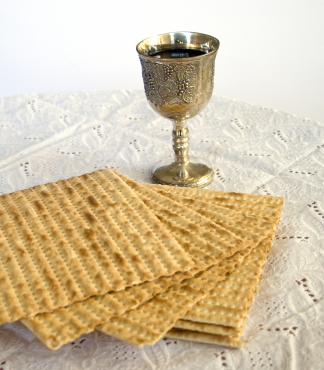
respecting the eighth day of a Diaspora Passover

Someone raised a discrepancy today: Unleavened bread is commanded to be eaten in the Laws of Moses for seven days (Exodus 12:14-16). Yet contemporary observance in the Diaspora goes for eight (thus ending tonight and not last night as in Israel). The conversation which followed was enriching for me at least, so thus I am producing some of my findings.

So how did this tradition come about? I had ideas but was not sure, so I googled to get concise truth.

Sunday, April 04, 2010

On the facticity of firstfruits;

Make no mistake: if he rose at all
It was as His body;
If the cell's dissolution did not reverse, the molecule reknit,
The amino acids rekindle,
The Church will fall.

It was not as the flowers,
Each soft spring recurrent;
It was not as His Spirit in the mouths and fuddled eyes of the
Eleven apostles;
It was as His flesh; ours.

The same hinged thumbs and toes
The same valved heart
That--pierced--died, withered, paused, and then regathered
Out of enduring Might
New strength to enclose.

Let us not mock God with metaphor,
Analogy, sidestepping, transcendence,
Making of the event a parable, a sign painted in the faded
Credulity of earlier ages:
Let us walk through the door.

The stone is rolled back, not papier-mache,
Not a stone in a story,
But the vast rock of materiality that in the slow grinding of
Time will eclipse for each of us
The wide light of day.

And if we have an angel at the tomb,
Make it a real angel,
Weighty with Max Planck's quanta, vivid with hair, opaque in
The dawn light, robed in real linen
Spun on a definite loom.

Let us not seek to make it less monstrous,
For our own convenience, our own sense of beauty,
Lest, awakened in one unthinkable hour, we are embarrassed
By the miracle,
And crushed by remonstrance.

- the late John Updike, "Seven Stanzas at Easter"

Sunday, March 28, 2010

Newly Kosher for the White House

Last year's White House Passover seder, a new tradition instituted by President Obama, apparently did not come without problems:
Then came what is now remembered as the Macaroon Security Standoff. At 6:30, with the Seder about to start, Neil Cohen, the husband of Michelle Obama’s friend and adviser Susan Sher, was stuck at the gate bearing flourless cookies he had brought from Chicago. They were kosher for Passover, but not kosher with the Secret Service, which does not allow food into the building.
May your Passovers be joyous, and without major security problems.

Friday, March 26, 2010

holiness as true freedom

At a rollicking debate Wednesday night on the existence of God between William Lane Craig and Michael Tooley (short story: Craig won, and the God of Israel exists), Dr. Craig illustrated a key premise of his moral argument by noting that without a moral law giver, and hence without objective moral facts, something like "murdering babies for fun," instead of being objectively wrong, would be "unfashionable ... like Lady Gaga" (!). This brought welcome laughs, but I think Dr. Craig was being clever in a purpose beyond levity. Now it is not my interest to comment on his argument, but rather the spiritual significance of Lady Gaga.

Friday, March 19, 2010

The furtive patakh and how to transliterate ישוע

I inserted this into the middle of an unnecessarily-mega post on Messiah's Hebrew name. But I really wanted to stop doing that after say 24-hours of making a post. So here it is. 

May you live to be 120!

Via Israel21c, David Pur, who lives in Israel, is to be declared the oldest man in the world:

Born in 1895 in what was then Persia and today is Iran, Pur became an adviser to the Shah, who admired his mastery of languages, including Persian, Hebrew, Arabic, Aramaic and French. He later added Tagalog, while learning to care for Filipinos. He and his family came to Israel in 1948.

A commenter couldn't help but notice a strange math issue though.
Today, the man who smoked for nearly 110 years and has a glass of brandy and some nuts for breakfast seems to know instinctively what recent Israeli research has proved - that increasing vegetables and cutting out trans fats and processed foods can reverse hardening of the arteries. "I avoid meat and fried foods, and eat as many fruits and vegetables as possible," he says. (emph. mine)
He is now 115. Did he really start smoking not long after he turned five?

Wednesday, March 17, 2010

Что нового? New Russian site!

I am surprised there were no posts for Feburary and half of March, especially since there are many things worth blogging about for that stretch of time! Among other things, if you are by any chance a Russian speaker please take a minute to check out our Russian site made through the help of Heaven as well as the gracious talents of Natalia Fomin, and to which content is added regularly. Also, if you would like to help, please do pass it along to Russian-speaking friends!

Tuesday, March 16, 2010

Restoration of "Yeshua" vs. accommodation to "Yeshu"

The most popular Hebrew term used for Jesus is "Yeshu," a word spelled with three Hebrew letters. You find this in textbooks, newspapers, and in conversations about Jesus.

However, “Yeshu” is generally not the term used by Messianic Jewish Hebrew-speakers. The reason is simple: other than as the negation "may his name and memory be blotted out" (yemach shmo vezichro ימח שמו וזכרו = y-sh-v --> Yeshu יש''ו, often written without the abbreviation marks as ישו), the name has no clear meaning or origin.

Often, a Hebrew-speaking believer has the experience of being asked if she believes in "Yeshu" ישו, wherein she responds that no, she believes in "Yeshua" ישוע (which means "the Lord saves"). Her clarification then may be met by skeptical looks and the question: "who is this Yeshua?"

Is "Yeshua" Jesus' name in Hebrew? And how do we know?

Sunday, January 31, 2010

Snares

...the social supports ... for guidance--churches, ethnic communities, patriotic activities, and a liberal arts education--have either disappeared or now appear ‘plastic’ and unreal. Enduring this kind of acutely felt tension, these young people yearn for a quick cure for their sense of isolation and confusion (Lofland and Stark, 1965). They seek a sense of full belonging and purpose in life, independent of their familes, but without engaging in the struggle to achieve true "mutual understanding" between individuals or the serious "analysis" of their situation required to find and shape their own identity. ... Then at a moment of crisis, a "turning point"... they encounter the missionaries of one or another New Religious Movement offering just such an alternative path to (or temporary detour from) maturity. (Comprehending the Cults: The Sociology of New Religious Movements, 91)